

NO.
03.
Done+Dusted
Ran an AI operations assessment for Done+Dusted, the live-event production company behind the Oscars and the Super Bowl halftime show. Two days on site in Santa Monica, 18 sessions, and a roadmap the team started running before the report landed.
The brief
FIG. B · 01Done+Dusted produces live entertainment at a scale most companies only watch. The Oscars, the Super Bowl halftime show, the Grammys, Google's keynotes. Four hundred shows over 25 years, run by a core team small enough to fit in one Santa Monica office, in the middle of the busiest year the company had ever had.
The ask started as a creative audit. AI for pitch decks and pre-vis, the kind of work I do most. But by the first call with the CEO it had turned into something else. Nobody knew what the company was paying for in AI tools. Nobody knew what was allowed. And the people carrying the operational weight (a small group doing the scheduling, budgets, reconciliation, and pitches for every show) had no time to find out.
So the job changed. Get in the building, map where the hours were going, find the AI moves that fit how a live-event shop runs, and hand back a roadmap the team could act on without me standing next to them.
The approach
FIG. A · 02I started with the survey. Twenty-six people, partner to coordinator. I rebuilt the questionnaire before it went out to ask how each person's week actually runs and where it hurts, split between what the company pays for and what people pay for out of pocket. That last question turned out to be the whole story.
Then two days in Santa Monica. Eighteen sessions: 1:1s with the partners and producers, group sessions by role, the partner bi-weekly, the all-staff. The rule for every session was the one I use for creative work. Sit with the actual job. The Amex statement, the 72-page subscription PDF, seven months of one calendar, a single meeting invite that had generated 65 duplicate emails. That's where the hours leak.
The scope was assessment. Building started anyway. An expense reconciliation workflow, built live with the business ops lead, caught charges the manual pass missed. A subscription top sheet came out in minutes, a job that used to eat about two days a month. A prompt amplifier, built in the room, shipped with its own install guide.
Every claim in the report traces to a session recording, survey response, or document reviewed on site. That standard makes a roadmap something a CEO can act on.
The work
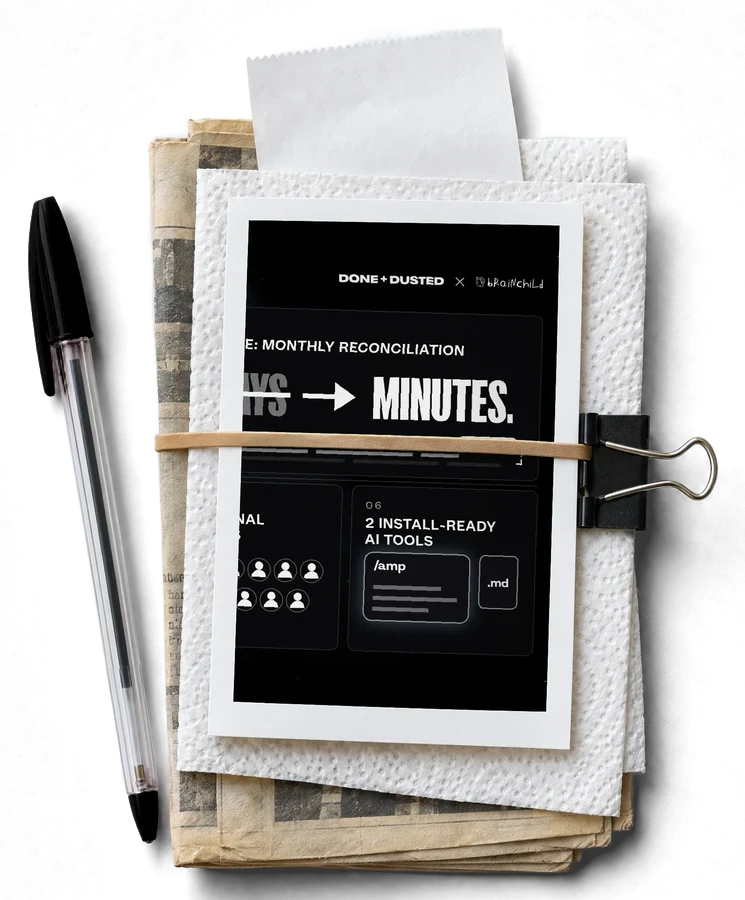
FIG. W · 03The package landed September 2, two days early: a 25-page AI Operations Assessment and Roadmap, a tooling and spend review with four consolidation plays ranked by return, a one-hour Start Here guide (ChatGPT and Claude versions), eleven personal debriefs (one page each, one per desk), and two install-ready tools with their own guides.
With the numbers in one place, the findings were plain. No AI policy meant 18 of 26 people were guessing what they could safely put into a model, and 15 paid for tools out of pocket. The same 15 named scheduling and email as their heaviest work. Eleven still built decks from scratch, nine didn't trust the output, and the six platforms holding the company's files didn't talk to each other.
The roadmap had three moves: put the permission answer in writing (a one-page policy with a green-yellow-red rule for what data goes where), turn the private systems people built for themselves into company infrastructure, and make the IT approval request specific enough to get a yes.
Quick wins scoped in weeks, standardization across the quarter, bigger bets for Phase 2. Within two weeks of delivery, one Copilot move cut 1.5 to 2 hours a week off a coordinator's end-of-week summary, and a production exec built his first Claude skill on his own.
Phase 2 was requested before the report landed.